
Biology Made Real By Christian Moore (Part 1)
STORYBOOK TAKEAWAYTEACHING & LEARNING
1/1/20262 min read
One sentence summary:
The first three chapters of this book talks about how biology becomes meaningful when students actively make sense of organisms, contexts, and relationships rather than memorising disconnected facts.
Some key ideas:
Meaning in biology comes from organisms, context, and relationships.
Chapter 1 emphasises that biology makes sense when grounded in living organisms and real contexts like health, forensics, and sport. Understanding is built by constantly moving between parts and wholes—genotype and phenotype, structure and function—through what Moore describes as “yo-yo learning”. Even scientists rely on everyday analogies to explain cellular processes, reminding me that meaning often comes from linking the microscopic to the familiar.
Teaching for meaning requires helping students discern critical differences.
Chapter 2 introduces variation theory, where learning happens when students notice contrasts—good vs poor examples, effective vs ineffective structures, correct vs incorrect reasoning. It’s not about covering content, but about identifying what students need to discern. Carefully chosen examples, non-examples, and analogies help students separate a concept from surrounding noise and integrate it with prior knowledge.
Learning should move from the whole, to parts, and back to a richer whole.
Chapter 3 shows how variation theory unfolds in classrooms: students first encounter an undivided whole, then examine critical aspects through contrast, generalise across examples, and finally fuse these ideas back into a deeper understanding. Experiencing phenomena before formal instruction often leads to better transfer, especially in biology where concepts are ill-defined and interconnected.
My thoughts:
"The components of a biologist's gaze could be thought of as organismal thinking, ecological thinking and evolutionary thinking."
These chapters offered me new ways to look at what it means to “understand” in biology. Instead of planning around learning objectives alone, I need to plan around what students must notice. Variation theory reframed my role—from explaining content to designing experiences that based on guiding students to discover meaningful differences.
I was also struck by the tension between reductionism and holism. It gave me a better understanding of how our syllabus came to be, and the alternative ways to look at the learning of Biology beyond just what the syllabus tells you. It made a lot of sense to me, that only through comparison, that we begin to appreciate how our systems came to be.
Ultimately, I really appreciated how this book showed me how learning Biology can be helpful to a student, and how it can be just as, if not more important than Chemistry and Physics. This helps me to better see the benefits of a Biology education beyond what they learn in syllabus, and how to curate experiences to help students develop another lens to better appreciate the world around them.
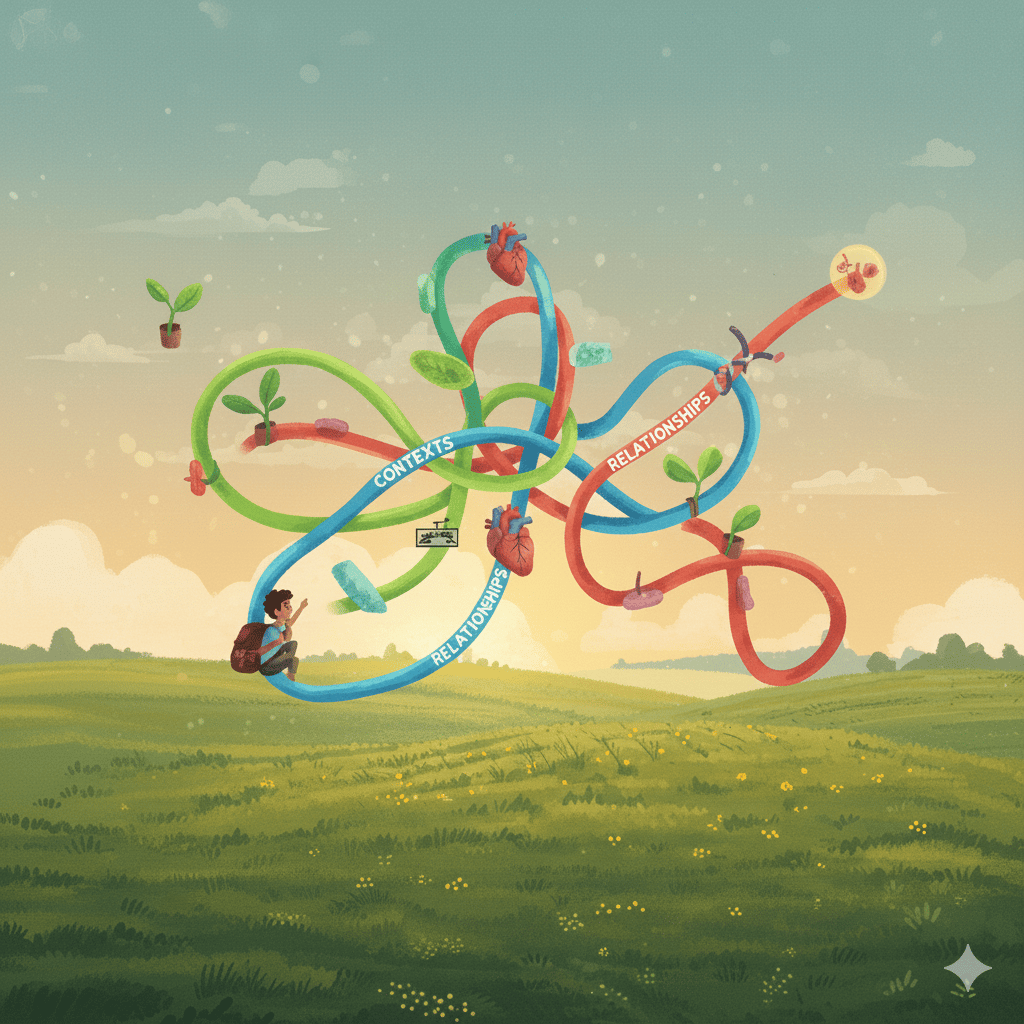
Disclaimer: This blog post is a summary of my written takeaways by ChatGPT and the cover image is generated by using the takeaway as the prompt in Gemini.