How to GRASPS setting performance tasks
This is a condensed version of the Science Teachers workshop sharing by SST.
TEACHING & LEARNINGTIPS FOR A NEW TEACHERTECHNOLOGY FOR LEARNING
1/17/20263 min read
A framework to create performance tasks
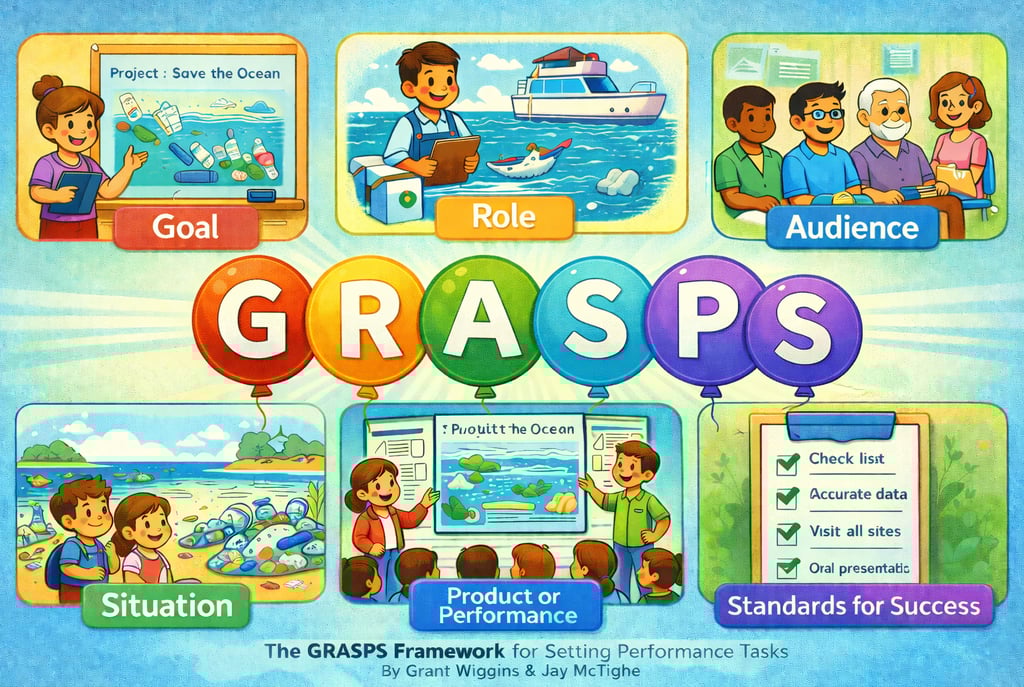
This is a presentation of my learnings from the Science Teachers workshop organised by School of Science and Technology on how to create performance tasks (PT). It teaches us how to use the GRASPS framework by Grant Wiggins and Jay McTighe. The planning sheet shared by the authors are here.
My thoughts
I find the framework helpful for schools that starting to embark on project-based learning or alternative assessments. It offers a quick structure to follow, reducing resistance to start on it as we now have a quick guide to follow.
Simplifying the process
I realised in the workshop, that many chapters and learning outcomes can be made into a performance tasks. What we need, is to remove some of our limiting beliefs on what chapters are suitable. GenAI like ChatGPT, Gemini, Pairchat etc are helpful tools in helping us see what are the possibilities.
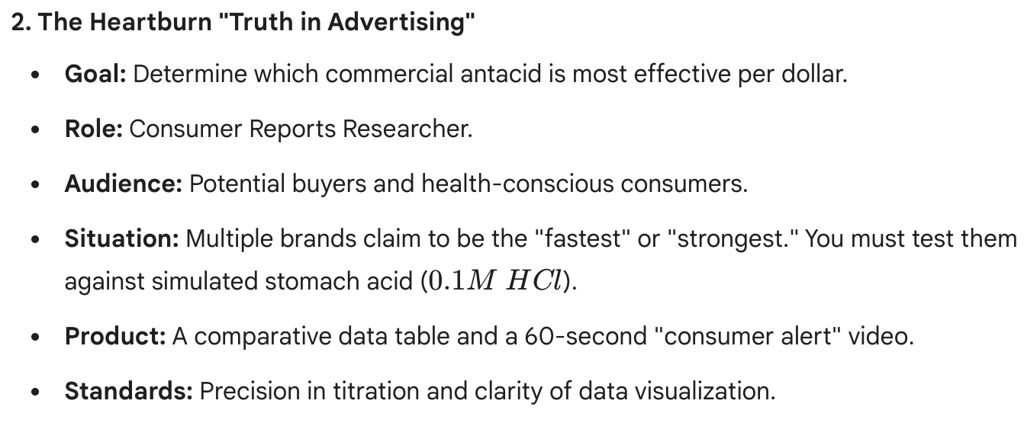
Here is an example of the prompt my group used to find a possible performance task for Secondary 3 students on the topic of Acids and Bases.
What are 10 possible interesting performance task with real world context for teaching neutralisation reaction? Use the GRASPS framework by Grant Wiggins and Jay McTighe.
Here is a screenshot of some of the results by Gemini:
Here, I will translate what I have gleaned from the sharing to a step-by-step work plan on how I would go about starting a performance task (PT) as an alternative assessment for the 1st time in my school.
Basic Implementation
Decide with department on the length of the PT (usually 3 to 4 weeks) and the timing of the PT (e.g. Term 2 or early Term 3.) Term 2 has added benefit of June hols if a lot of making time is needed for building the prototype.
Look at Scheme of Work to identify suitable topic(s) in Term 2 or early Term 3. (Sufficient time for teachers to prepare materials and far enough from end-of-year exam)
Put the topic and learning outcomes into GenAI using the prompt above, specifying to follow the GRASPS framework
Select a suitable idea and identify the resources and materials needed.
Some additional considerations:
What materials are needed to build the prototype? Is it provided by the school?
Where do we want the students to do research on? Worksheet/Booklet, on SLS, presentation slides
Is there a sample good and bad project report that students can refer to?
Is there a clear and fair rubrics? Especially if it concern examinations.
Do the students need to carry out any experiments in the science labs? If yes, are there sufficient time slots that students can book and teacher can supervise?
Based on the answers to above, prepare the necessary i) materials (if provided by school), ii) worksheets/SLS package, iii) rubrics, iv) venue booking system (if use of lab needed)
Preparation of materials & apparatus and briefing slides.
Brief the students, distribute the materials and watch the students carry out their PT! :)
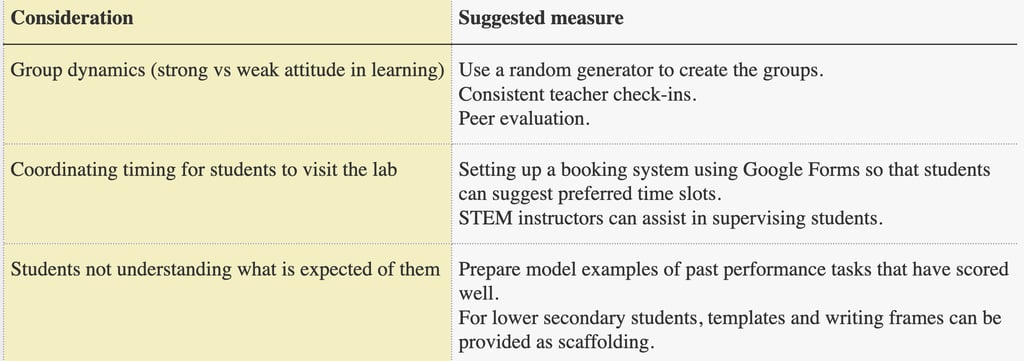
Considerations when implementing PT
Possible Enhancements (after 2-3 rounds of successful implementation)
Interdisciplinary - As shared by SST, they had PTs that spanned across more than 1 domain of Science e.g. Chemistry + Biology. There are also colleagues from other schools that shared about possible collaborations with other departments.
Poster making - Students can be given the opportunity to make a scientific poster, and present it to their friends during poster day.
*The cover image is generated by Gemini