My First Failed Attempt at Jigsaw (◞‸ ◟)
TIPS FOR A NEW TEACHERTEACHING & LEARNINGTECHNOLOGY FOR LEARNING
5/4/20254 min read

I do not feel like putting out a storybook takeaway when I have not properly reflected on my thoughts after reading. As I pondered what to write for this week's post, this failure of mine two weeks ago came back to 'haunt' me. Maybe, its a sign for me to document and unpack it...
It is not easy confronting one of my bigger failures, but I felt that this misstep has evoked quite a bit of feelings and thoughts in me, urging me to have an making sense of it. While wondering how to go about this, I am pleasantly surprised that the Reflective Teaching Model subconsciously came to mind. Some tools taught at NIE can be handy for handling real life crisis.
So, here goes...
What happened?
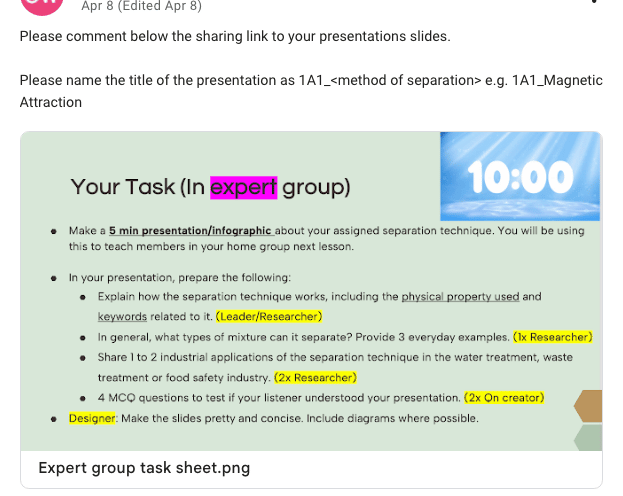
This happened to my Secondary 1 G3 Science class on the topic of Separation Techniques. I wanted to try out jigsaw pedagogy* as this is a class of rather high ability students. Students were split into expert groups to each learn about one separation technique and create a short presentation to be used to peer teach when they go back into their home groups. Then, they would apply their learning to solve a complex, authentic problem in terms of saving a town who's clean water supply was polluted due to a flash flood.
Through this process, I learnt how to better use ChatGPT to aid in lesson planning, but also painful lessons on how NOT to run a group project. Here is a breakdown of the what, why, so what and now what for the parts that worked out and the parts to be improved on.
Note: Each point is linked to one another. E.g. point 1 of what when well in the 'What happened?' section is linked to point 1 of what went well in the 'Why?' section, so on and so forth.
What went well:
I created an authentic problem that was interesting for the students to solve.
I created a worksheet with answers that addressed the syllabus' learning objectives and phrased appropriately in a short period of time.
I was adaptable enough to not persist with the pedagogy when I recognised students were not learning from it despite the lost time.
Area for improvement:
Students were mostly chatting among themselves and unable to complete their task despite me giving them 2x 40 min periods.
Most expert groups were unable to provide the slides I had expected despite the structure which I added in impromptu.
One student even exclaimed that its another lesson with no need to learn when I gave them time to work on their presentations.
Eventually, things only improved when I took over the teaching of the separation techniques from the expert groups and made them discuss in pair work instead of group work.
Why?
What went well:
I managed to write a concise and accurate prompt for ChatGPT to generate what I want.
I tried out ChatGPT's worksheet generation feature and suggested updates.
I walked around and got students to post their sharing link on Google Classroom so I could monitor their progress.
Area for improvement:
To be fair, I did make assign roles to each student in the expert group. However, I underestimated how playful they are and I was not firm enough with my expectations for discipline. Additionally, students tended to zone out when they did not have a personal learning device (laptop).
I had not put in place enough structure to restrict where they can include information from. Many students relied on their primary school knowledge or just on Google and ChatGPT. This led to presentations that were too simple or difficult for their level.
Students were not productive and chatted with their friends during group work aspects.
Students were more able to focus when they are in pairs. This could be because they were always used to learning in smaller groups, and that I took over some of the teaching load from them.
So, What?
What went well:
ChatGPT can be a helpful teaching assistant especially for generating lesson ideas for authentic learning and problem based learning.
ChatGPT has the capability of creating properly formatted worksheet with answers to reduce the time I need to craft lesson materials from scratch.
The routine for students to put up the sharing link and the roles of each group member will be continued in future group projects to make it easier for me to monitor progress and hold students accountable.
Area for improvement:
Pre-empt them the time that is given and what they need to produce.
Restrict students to the pages of the textbook and notes to look at to obtain their information. Students are not allowed to obtain information from websites, other than pictures. I should model the research process.
I assign the groups and try to teach working in pairs before moving on to larger groups.
I can teach some related content and show them an exampled of how the presentation should look like before giving them the assignment.
Now what?
What went well:
Use ChatGPT more to help in lesson planning.
Use ChatGPT more to help in resource creation.
Identify more routines and expectations that help manage students during group projects.
Area for improvement:
Create demos or compile seniors' presentations to give students an idea of what to produce.
Focus on limiting the research space at the start to just textbooks, before slowly expanding the space, and finally letting them out onto the web to do self-directed learning.
Use pair and small group works to train group work norms before moving to larger group work.
Teach students how to approach the assignment rather than leaving it to their own interpretation.
* For those interested, the prompts I used to craft this lesson are available here.
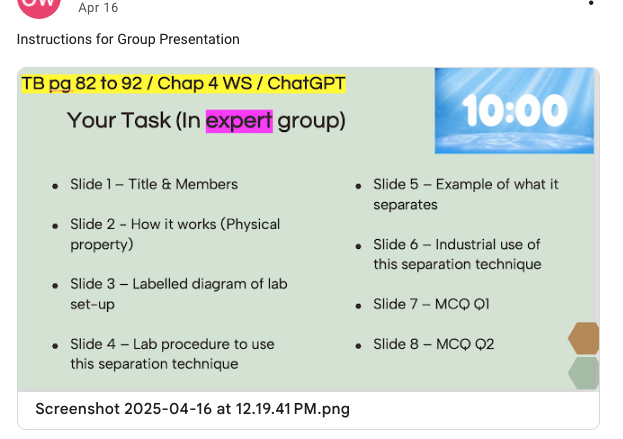
Here is an image of the structures I had in place for my students during this failed jigsaw.
Task and role assignment
What to include in each slide